It Shouldn’t Be A Secret, But It Is
The primary cause behind rising costs, AND positive investment returns, is often the most overlooked aspect of personal finance. It shouldn’t be a secret, but it is.
The answer’s too complicated for some, too simplistic for others, and too contrarian for all. Going forward, ignorance comes with a 100% no-money-back guarantee.
It took me way to long to learn the secret: I don’t need to outsmart the system, pick the best shares, or master the budget. I don’t need to be the smartest person in the room either. Instead, I just need to accept the inevitability of things that are going to happen.
There’s a train barreling through a desert, and I can either get on board, or get out of the way – regardless, nothing stops it.
No More Secrets
The current central banking and currency system, which relies on constant debt growth (both private and public), is a gigantic house of cards that can never stop being built.
It’s like a Ponzi, a pyramid scheme, and a shark that sinks if it doesn’t move forward. If the amount of debt/credit in the system is not in constant growth mode, the system crashes. It sounds bad (and it is), but there’s a strategy we can use to come out on top.
This Is Nothing New
Apart from a few brief moments in time, total debt in the US system has been on a continuous growth trajectory for over 110 years. We can partially thank the folly of ignorant adherence to Keynesian Economics in universities and central banks for all this, but we’re all to blame. It’s the incentive structures that politicians, businesses, and households are all subjected to. If politicians can find a way of delivering more with a lower tax burden, and if businesses can access cheap capital to scale, and if we can live the most abundant life today, without waiting, then why not borrow?
Like unwitting hands on a Ouija board, we collectively create the tide that lifts all boats.
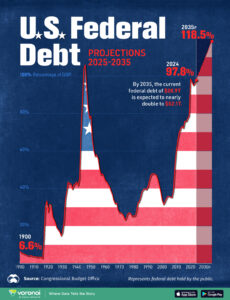
The ‘system’, and by system let’s just say it’s a group of independent bodies (banks, regulators, institutions, governments etc) all acting according to their own self-interests, historically rotates around private and government debt growth. It’s true in the US, in Canada, Australia, the UK, and yes, in New Zealand also.
Why do property prices always grow? Debt growth.
Why do companies become more ‘valuable’ over time? Debt growth.
Why is there a constant growth in GDP? Debt growth.
*This is not strictly true of course, but it’s mostly true.
Put another way, most businesses, governments, and even you and me personally, are incentivised to enter into higher debt levels over time.
In the process of seeking out credit, we engage in currency creation (ie we are all responsible for debt growth). Every time we provide justification to a lender (be it a retail/commercial bank, or a central bank, we conjure into existence new dollars which literally came from nowhere, and we’re diluting the value of all existing dollars in the system.
THIS IS WHY the price of what we need, and what we own, will always increase over time. This is also why an investment strategy that uses debt to acquire scarce assets, will always win.
My Own Journey Of Discovery
At the start of my own wealth building journey, I thought it was about picking stocks, or buying the best type of investment property. These activities can indeed provide an edge, but by far, the vast majority of ‘heavy lifting’ in terms of investment performance, occurs from the activity of currency debasement (as described above). If I would have known it was as simple as buying scarce assets that couldn’t be created/printed as fast as the currency that could buy them, it would have saved me a lot of mental compute.
Recently, I attended a conference which centered on what I suspect will be the future of money in a more digital world. One of the best presentations I sat through was from author (of a book called ‘Broken Money’) and macro-analyst Lyn Alden – ‘Nothing stops this train’. The current form of money we use (fiat currency) is tethered to a leveraged system with no easy way to deleverage. Ironically, the strategy we can use as households to build wealth (leverage to buy scarcity) is what may help our governments survive the train wreck coming.